The modern football club is not focused on transforming into a brand. It is realizing its brand is one of its most underutilized assets for growth.
This article is about recognizing that every football club already has a brand, whether it actively shapes it or not, and whether it is globally recognized or striving to be.
At the highest level of the world’s most beautiful game, brand influences everything. How supporters connect. How partners engage. How the club shows up locally & globally. And how people feel when they wear the club’s jersey or see the club's badge.
At its core, brand is defined as “emotion”. Brand is emotion. It’s how people feel about a club and the connection they carry with them over time.
Brand is created as a result of what happens on the pitch and extends into the lives of fans well beyond the stadium. That is exactly why it deserves real attention.
Football clubs all have their own brand, whether they choose to shape it or not.
Yes, football clubs are clubs first, with fans at their foundation. What I am suggesting is that the brand already inherent in every club can be leveraged to strengthen commercial growth, deepen loyalty, and support performance.
Today, football clubs have an opportunity to better understand what their brand is and then leverage it with clear intent, locally and globally, with football audiences and with sport fans.
This is not new thinking. It has existed for decades. What has changed though is the scale of the opportunity.
Clubs operate in complex and competitive global environments. Attention, relevance, and connection extend far beyond football performance. The best clubs understand this and are building accordingly.
A quick note... while the perspective of this article is grounded primarily in the men’s game, many of the same principles apply, and in some cases even more powerfully, to the growth of the women’s game.
Growth in any business, comes from clarity. Knowing who you are and showing up consistently in a way people can believe in and emotionally connect with.
This is where I see modern football clubs succeeding.
Modern football clubs are becoming platforms... not just teams.
For a long time, the model was simple. Win matches. Fill the stadium. Build a loyal fan base. Sell merchandise. Deliver value to the fans, stakeholders, and shareholders. That still matters. It always will. But the scope of the opportunity has expanded.
Leading clubs now operate at the intersection of sport, culture, entertainment, commerce, and community. They will always compete for goals on the pitch and points in the table. But the competition for market attention, cultural relevance, audience growth, partnership value, and long term relationships has never been more important.
As ownership models evolve, this becomes even more pronounced. Clubs are increasingly part of broader multi-club / sport portfolios, where alignment across brand identity, commercial strategy, and cultural positioning multiplies in importance.
City Football Group is the clearest example here, with ownership stakes across 12 clubs on 5 continents and a stated identity as “the world’s first truly global football organization,” reaching over 1 billion followers.
But you can also see this intersection with clubs like Newcastle United, where ambition, ownership, and global visibility combine to leverage the legacy and culture of the city and its loyal fans. This creates a tremendous opportunity to build a globally relevant brand, both on and off the pitch.
The shift from team-driven to platform-led changes what growth looks like at clubs. It also changes how leadership needs to think… which some of the best are already doing.
Brand is no longer a communications function... it is a growth driver.
For years, brand in football has often been treated as something that shows up as a part of marketing. Through campaigns, content, and creative. In sponsorship placements, marketing, merchandise, and fan communications.
The clubs creating real advantage today treat brand very differently.
The modern football club uses brand to shape perception, strengthen commercial leverage, define market position, and give partners something meaningful to align with.
Brand is not the badge. It is the feeling people get when they wear the badge. Determining how to harness this emotion is what makes brand so powerful for clubs today.
When brand is treated as a strategic growth driver internally at clubs, everything else becomes easier to align. Revenue opportunities become clearer. Partnerships become more valuable. Fan engagement becomes more intentional and authentic.
While there still is a lot of value being left on the table by clubs of all sizes, the club’s that understand and embrace that brand drives growth are the ones that find success.
Growth now depends on integration... not functional silos.
One of the biggest constraints on growth today is not resources. It is organizational structure.
Brand, commercial, partnerships, marketing, digital, and supporter engagement often sit in separate lanes. Each internal team may do strong work, but without alignment and a mandate for collaboration from strong leadership, fragmentation can creep.
I’ve seen this first hand building brands throughout my career. Creating a singular voice to share across markets sounds simple. But once multiple teams and perspectives are involved, identity can drift. Messaging can lose clarity. Connection can weaken. This is typically when the belief in brand is abandoned and the functional silos of marketing, sponsorships, and commercial re-activate in separate silos with goals of achieving specific short term departmental results.
Modern football clubs understand that brand dilution or confusion cannot happen. As club’s show up in new markets to new audiences that speak different languages and embrace different cultures, one thing always needs to remain the same. The identity of the club and the feeling people get when they engage with it. This is the brand of the club.
A club's advantage comes from connecting the right pieces so that identity, storytelling, partnerships, commercial planning, and audience development reinforce each other.
One club. One integrated system. One voice.
Alignment becomes even more important as activity increases across markets. The clubs that get this right move faster, operate with more clarity, and get more out of what they already have.
If audiences are ever unclear on what a club stands for, they move on. Clarity gives them something to connect with. And over time, that connection becomes loyalty. With the ultimate goal that these audiences turn into and remain lifelong fans.
The best partnerships are aligned… not just valuable.
A partnership is more important than the financial gain that is generated by the commercial department that secures the deal.
Additionally, a partnership is not a sponsorship, or sponsorship 2.0 under a different name.
Partnerships signal identity, not just create revenue. They reflect who the club is aligned with, what it values, and how it shows up. That is why the best partnerships go beyond commercial value. They are strategically and culturally aligned.
You see this with clubs like Brighton & Hove Albion, who are deliberate about who they partner with and, just as importantly, who they do not partner with. That level of discipline protects the club, builds trust, and strengthens the platform over time. It increases the understanding audiences have about the club and deepens the relationship that fans have with both the club and their partners.
Sustainable long term growth is a result of partnerships that hold together through wins and losses and over multiple year relationships, not one year contracts..
The strongest partnerships extend relevance into the market without pulling the club away from foundation, its core, its identity. The modern football club recognizes this and strategically curates their partnership portfolios with discipline, even when it means walking away from short term financial gain.
A modern football club is inclusive to fans and exclusive to potential partners. This is to protect a club’s brand and the fans relationship with them.
Global growth requires clarity of identity… not dilution.
Almost every ambitious club today is thinking about global growth. New audiences. New markets. More reach.
The challenge is clear. How do you grow while staying true to what makes the club distinctive?
Global growth amplifies identity… it doesn’t replace it.
The clubs that expand best are clear at home first. They understand what makes them unique and then translate it into a broader cultural language. They build from heritage, culture, supporter base, values, place, and style. They don’t try to mean everything to everyone.
You see this across Europe. Clubs like FC Porto have built strong international relevance by staying grounded in a clear local identity first and then extending it consistently across markets.
They carry a challenger mentality within Portuguese football, competing against bigger names Sporting CP and SL Benfica. That translates globally into a brand that feels authentic, tough, and unapologetically themselves. The credibility of their badge and performances from their team reinforces this. They are seen as a club with underdog energy, but with a pedigree that is respected, dangerous, and never overlooked.
They have built their club globally from clarity of identity, a disciplined growth model, and from football performance itself, not from marketing. That allows the club to stay grounded in their northern Portugal roots while showing up globally with a distinctiveness fans are drawn to.
In a crowded global landscape, clarity of identity is a clear advantage.
From functions… to an integrated growth system.
The next phase of growth will not be driven by any one function or department. It will come from how well clubs integrate and align brand, partnerships, culture, and commercial strategy into one system.
While all clubs operate with different budgets, ownership mandates, and organizational structures, most clubs already have the core pieces needed to leverage their brand more effectively.
The difference in clubs finding success off the pitch is not determined by capability or even resources… it is by alignment and execution.
From my experience, and from many recent conversations across global football and the broader sports landscape, a well aligned system looks like this:
Brand defines club position and meaning. Partnerships extend club relevance in markets. Content maintains connection between club and it’s core asset, fans. And commercial strategy drives sustainable, long term growth.
When those elements work together in one system, they compound brand power.
The shifts defining the next era:
Brand becomes infrastructure, not campaign. Brand sets direction, guides decisions, and creates consistency as clubs scale.
Partnerships become platforms, not inventory. Built as relationships, not just sold as rights and placements. Long term, aligned with brand DNA, and culturally relevant.
Content becomes owned media, not support. Clubs are no longer just participants in media. They are publishers with direct relationships to global audiences… owning the data, content, and connections that brand helps create.
Revenue becomes ecosystem driven, not linear. Financial growth comes from the connection between product, experience, partnerships, media, and audience. It is not a straight line… it is all connected.
Global audiences become core, not peripheral. Local supporters will always remain the foundation of each club. Global audiences increasingly shape how clubs grow and build relevance in new markets. Understanding both, and the differences between them, allows clubs to grow with more clarity and intent.
The clubs that win next will build brand value... not just revenue.
The clubs best positioned for what comes next are building long term brand value, not just maximizing short term financial opportunities.
That shows up in stronger market position, more resilient revenue, better partnerships, deeper audience connection, and greater cultural relevance.
Performance on the pitch will always matter most. But the clubs that separate themselves will be the ones that treat brand, partnerships, commercial strategy, content, and identity as central to how value is built.
To close this article... with emotion.
In 1994, when I was a senior in high school, I had one of the most surreal moments of my life. I saved a shot from one of the greatest and most iconic footballers of all time.
The Italian national football team chose my high school to build a field and train while they were in the USA for the World Cup. One day, Luca Marchegiani tossed me his gloves and motioned for me to step into goal.
The next thing I remember, players were walking out to warm up. Giuseppe Signori, Gianfranco Zola, Paolo Maldini… and then Roberto Baggio.
They started taking shots from outside the box.
It’s a bit of a blur now, but one moment is still crystal clear in my mind 30 plus years later. A shot came in, I dove, made the save, hit the pitch just in front of the goal line, and stood up to Baggio clapping and giving me a hug.
I will never forget that. That moment was emotion.
At that point, Baggio represented far more than a world class player, or even the star of the Italian team. He represented something bigger. The game. The culture. The connection people can feel to it.
And that feeling stayed with me. Forever. That is what brand is in football.
Global football has without a doubt entered a new competition. Not just for the best players, the most trophies, or the highest financial return… but for relevance, distinction, attention, and emotional connection with audiences around the world.
The clubs that operate with clarity and alignment across brand, partnerships, culture, and commercial strategy have a clear advantage.
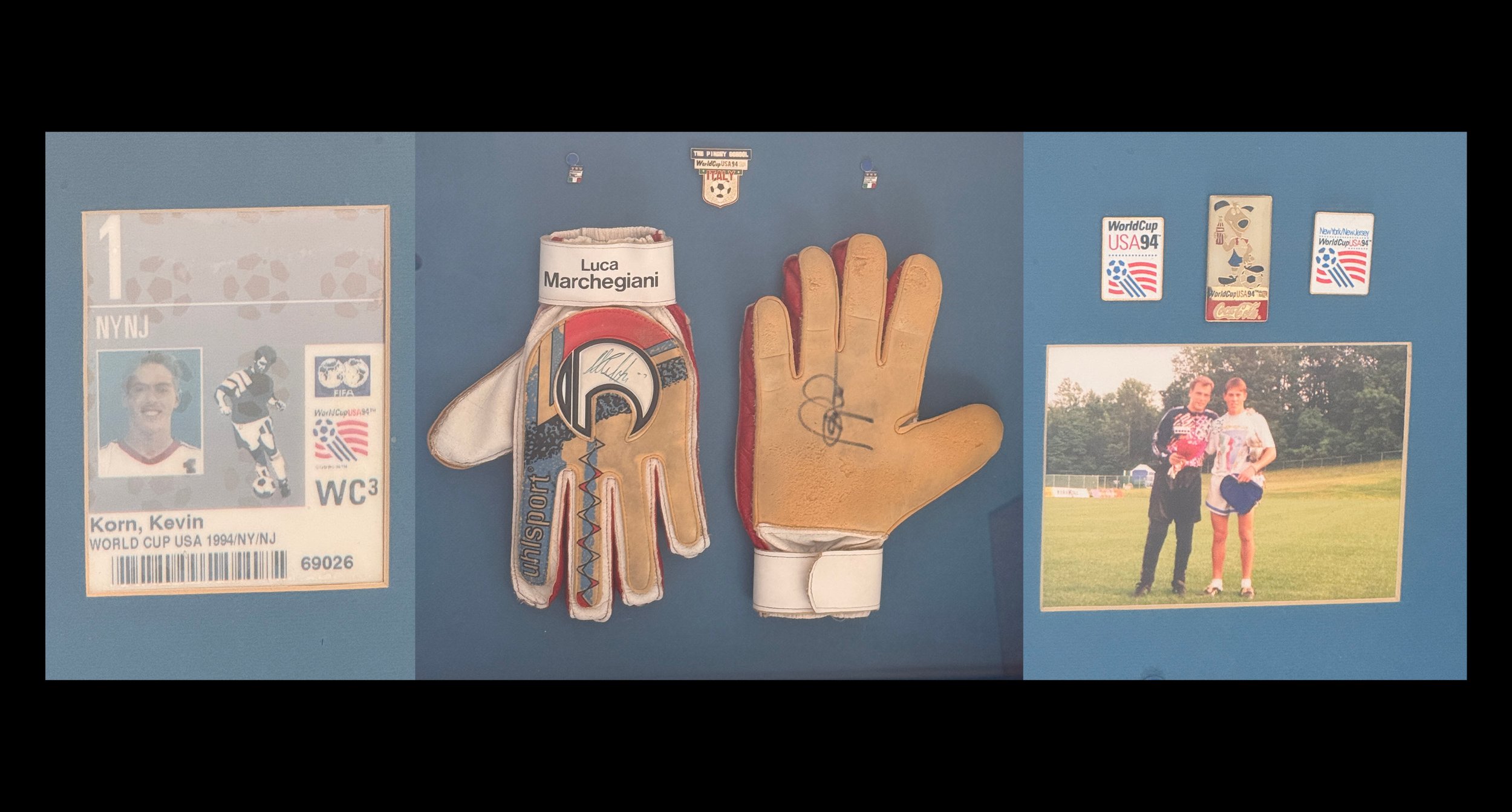
This collage hung in my room for years after the 1994 World Cup. Now it hangs in my 13 year old son's room. We both follow the Italian National Team. Not by ancestry... by emotion.